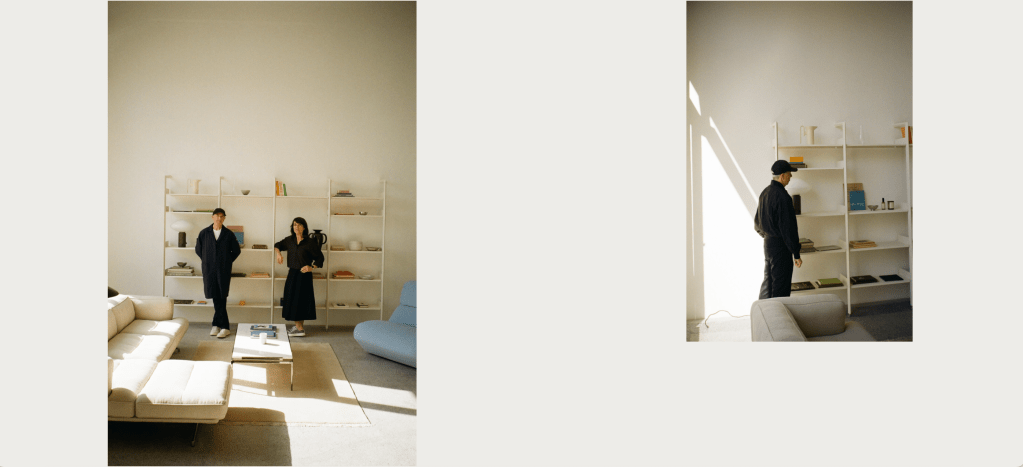
Created by London-based design studio Industrial Facility, the new Rombe shelving is a modular system that is flexible and considerate of modern needs. An exercise in tension, Industrial Facility designers Sam Hecht and Kim Colin unravelled a plethora of paradoxes and reassembled them neatly within one design – simply by asking, “What is the difference between storing and displaying?”
Taken from their 3daysofdesign talk, The Printed Page, hosted in our Copenhagen home and showroom, the following excerpts piece together a picture of Rombe in Industrial Facility’s own words, and touch upon their recent book release from the room to the shelf – a collaboration project with &Tradition.
KC: Rombe has to live with many different things. It needs to become a part of lots of different spatial settings, as well as fitting into many different architectural styles. There is a richness to these conditions, and we are all personal, individual curators of them. A lot of the time, when a product launches, it can seem as though it were envisaged to be the only thing that existed in a room, but in reality, it will live with many other moving parts. We don’t fantasise of a room with solely Industrial Facility products, that – as a room, to us would be a very scary one!
KC: There’s an interesting tension that exists between the wall and Rombe. &Tradition asked us to make a wall-based system, that in fact touches the wall in the lightest way or at the fewest points possible. This is because people may be living in a historic building with beautiful panelling that can reach quite high, or they may have spent hours carefully choosing a colour to paint their walls. We made a system that can bridge this panelling, and also let colour come through from behind – which in turn changes the perception or the character of the shelving. Of course, it’s a system that has many stabilities, both internally and structurally, but in terms of how it’s installed and the way it respects the existing architecture, it’s unique.
SH: When you look at Rombe, there are no visible fixings – you may not even be able to understand how it stands up and how the shelves are so strong. But the idea was that we don’t need to see the inner workings of the design all the time.
SH: There were two parts to the development of Rombe: sculpture and utility. The sculptural part is essentially removing it of all its visible connections, yet maintaining full adjustability. Sculpture also comes from the subtle rhomboid shape found in the upright brackets – which give Rombe its structural integrity. The utility part is this idea of complete adaptability. The result, you could argue, is a continuous pendulum swinging between the methods of Prouvé and Rams. Rams being that you see the shelving and you understand it, you see where the screws go and how to adjust it by visualising it – rational, unconfusing, straightforward. Prouvé in the sense that there is an aura of mystery about it.
KC: Other than the obvious fact that books are typically stored on shelves, I think they solidify ideas. They are an analogue form of something that has longevity. Sam and I keep many old books that are quite close to us – we’ve always had a love for them.
KC: We felt that we had so much to say beyond the product. As this was the first project we were embarking on with &Tradition, it seemed like the right format to express these thoughts. It gave us a platform to capture the philosophy behind the work, the approach and the story. There’s an essay in there about how we’re living among other things – things we need to talk about, when it comes to Rombe.
 M A Richards
Leave a comment