Somewhere between
departures and arrivals
Used by millions, multiple times a day, transit lounge seating has become so much a part of our lives that, unless done badly, it is all but invisible. Contracts and commissions famously competed for by the world’s most innovative and highly acclaimed designers, we often take for granted the history behind the humble airport lounge sofa, lobby armchair or waiting room seating – the list goes on.
Wanting to pay tribute to some of the most overlooked but essential pieces of furniture in public realms, Anderssen & Voll’s Meantime collection for &Tradition reflects the quiet anticipation of something that is worth the wait. We take a moment with the duo to explore this context in relation to the new collection.
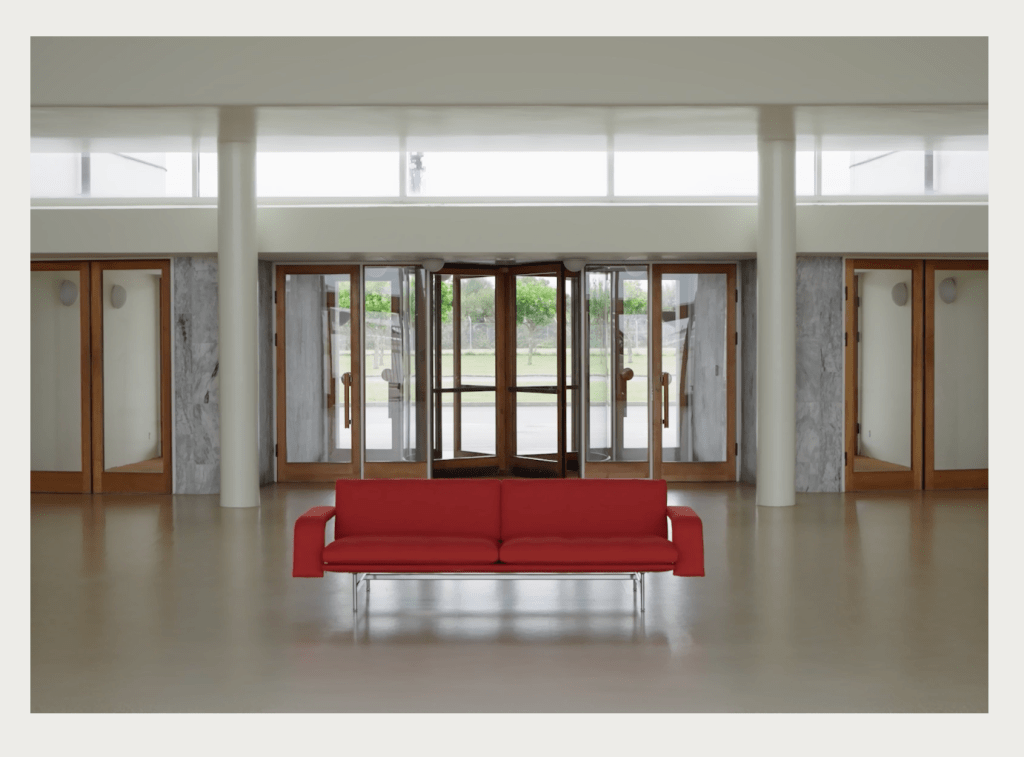
Designed for both residential and professional settings, Meantime is a three-piece lounge series–comprised of a lounge chair, a two-seater sofa and a three-seater sofa-that captures the essence of stillness amid movement. Reminiscent of furniture found in the liminal spaces of transport waiting–rooms, the distinguished silhouette of Meantime is accentuated by the wide, forward-reaching arms and precise material composition.
When asked, “What makes a public space truly great?” Field experts ranging from urban planners to interior architects highlight factors such as accessibility, comfort, and social connectivity. These qualities transform spaces from mere transit points into community hubs where the possibility of meaningful exchange is ever-present. While these principles are often discussed in relation to public spaces, they are equally relevant in private settings – where the right furniture can create inviting atmospheres for relaxation, conversation, and connection.
To turn communal spaces – both public and private – into welcoming focal points of interaction, what elements should we prioritise? Jan Gehl’s seminal book, Life Between Buildings, widely regarded as a cornerstone of human-centred urban design, offers valuable insights. Among the key contributors to hospitable spaces, Gehl places significant emphasis on furniture – particularly seating. Thoughtfully designed and well-placed seating fosters engagement, encourages moments of pause, and transforms environments into places people want to be. Taking cues from this, Meantime balances the presence and durability expected of public seating with the softness and comfort essential for the home.
Tørbjorn, how does Meantime, your latest collection for &Tradition, fit into this diverse, complex concept of public seating?
The wide armrest is a major part of the Meantime design identity. The arched armrest connecting the back to the seat is to us a universal feature of public transit hall furniture. We like to think that while you’re sat in these types of transitional spaces, you might be anticipating something good; escaping to somewhere different, welcoming an old friend, or going home.
The slightly tilted seat makes for a laid-back attitude, encouraging you to sit back and let time pass. All of these considerations and reinterpretations of something well known, led us to the name, Meantime.
We took this traditional armrest theme – reworked it, upscaled it, softened it and domesticated it – hopefully arriving at a comfortable, low-lying and funky design that could be relevant in both public as well as in residential spaces.
Do you have any favourite public furniture pieces? What are the elements that left a lasting impression on you? How do they alter, or not alter, their surroundings?
I went on a trip to New York City last fall with my siblings and inevitably passed through MoMA. In a breakout area just next to the bookstore (I think) there was a group of modular sofas; in many ways plain boxy and conventional – but they were also super petite and, in that way, appeared so innocuous, so super normal. Low and small seating makes me feel like I’m in control and in good contact with the surrounding space.
Espen, you have recently been working on a large-scale project with the Norwegian governmentto create new, functional but aesthetically appealing outdoor furniture, to transform public spaces. Are you able to share some details of what makes good public seating and how that was also considered in Meantime?
The right to public access has deep roots in Norwegian and Scandinavian outdoor culture, and it has also played a key role in shaping the urban development. For me it is a fundamental belief that urban spaces and city streets belong to everyone. The goal is to foster inclusive spaces and urban furniture for what we call everyday democracy – environments where people can come together, overcome differences, share experiences, and exchange ideas.
Meantime blends informal and formal elements seamlessly. Its open, inviting shape features a solid, upholstered armrest that accommodates anyone wishing to sit, while its sleek, refined outline reflects contemporary architecture, making it a perfect fit for public spaces.
We’d like to ask the same question to you to Espen: do you have any favourite public seating pieces?
To me, staircases are the ultimate public seating. In many major cities around the world, they create the perfect amphitheatres – ideal spots to sit, relax, observe, and engage with your surroundings. It’s pure genius.
 M A Richards
Leave a comment