in conversation with Anderssen & Voll
One of the very first studios to enter our ever-growing list of talented creators, as &Tradition has re–shaped and redefined over the years, so has Anderssen & Voll’s working practice. Equipped with a refreshingly playful approach to rigorous design, we explore the process of building all-encompassing product families, illustrated in the recent line extensions to the Pavilion and Ville, as well as the continuous strengthening of our working relationship.
Looking back at those very first years, how do you feel things have changed in our collaboration?
TA: The brand has evolved from being kind of Scandi-noir into something that is much more international. It’s not purely Scandinavian, which we think is refreshing, as it gives us a lot of opportunities to express ourselves in all shapes and colours.
EV: Companies change over time, but I think the spirit of &Tradition has been preserved. When a company grows, it can almost become more restrained in a way, but I think it’s still possible for designers to pivot in a new direction with &Tradition. For us, it’s important to feel that we have a collaboration with both the brand and the people we work with. We feel like we’re a part of the &Tradition and the designs we make communicate our understanding of the brand.
What about for you personally, as a design studio?
EV: The process in our studio has changed a lot. When we first started, we worked more computer-based, probably around the time of Pavilion. I believe we were just starting that transition then. These days, we are much more workshop based.
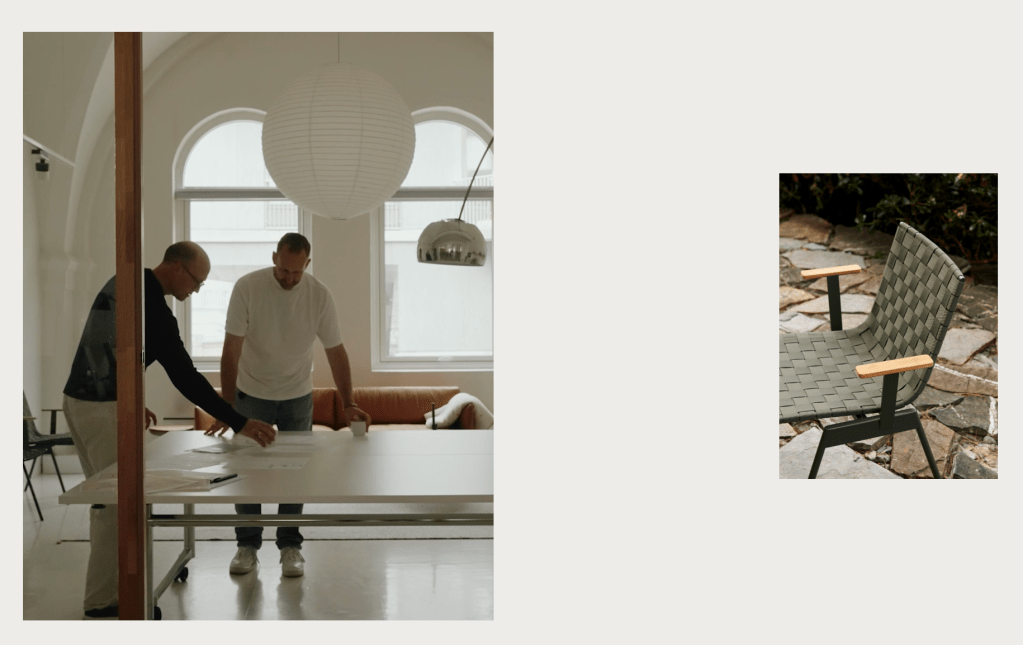
TA: Yes, and as you know, by the time we had reached Ville just a few years ago, we got the go-ahead from &Tradition on a super simple sketch we made for the first product, then the team instantly got going on making sections in the workshop and full-scale models. It’s a much more direct, quicker way of creating. It’s easier for everyone to understand and to refine as we go along as we can interact with our ideas in a different way and we get to know our designs in a more profound way; the meaning of details and their spatial presence.
If we look back at your time designing for &Tradition, can you see differences in your design process reflected in Pavilion, your first family for us, versus Ville, your most recent?
EV: Well, Ville is one of our first outdoor ventures and that’s a very different product category of course. Pavilion itself, however, is different from many of our projects. There was a very clear idea of building on history–trying to reinterpret history in terms of using more modern technology – and it was super successful. We ended up with something very unique.
TA: It’s very organic. It has this kind of grand piano feeling. But then the new sled base line extension, I say this all the time–it’s not just a Pavilion chair with a different base. It’s really a new product. It feels so complete–almost as if it could have been the original idea. This kind of loop that is formed by the way the steel tubes tie multiple shells together is a super clear representation of the original idea–it really creates such a vivid visual language.
These families have continued to grow and are now quite comprehensive. As you add to them, do you predetermine a design element to repeat throughout the series?
TA: The element presents itself. We’re not big fans of moving defining characteristics around as, to us, they tend to lose their meaning. If you have a detail that is meaningful or special, it’s because it’s serving a purpose in the objects it was designed for. It’s a very 90s way of making a family to take one detail and mass-apply it, so we don’t subscribe to the notion that all products should have this one element. In the same way–not all products should have line extensions either! But for Ville and for Pavilion for example, it felt very natural. Saying that, if you look at the tables, I think they are very different from the chairs. We are very strong believers that if you have a set of chairs, you want them to be different from the table to create a sense of peace. It should be different, otherwise they tend to cancel each other out.
EV: Yes, otherwise you lose some of the strength or power around the product. It feels flattened.
How do you strike that balance between distinction and consistency, within the families themselves?
TA: Each product is based on a strong idea. The ideas will set them apart.
EV: This idea can also develop into different forms and shapes over time and between products.
And when you say idea, what do you mean by that?
EV: Sometimes that idea can be intellectual or abstract. Sometimes we like to just discuss what a design could be. So, it could just be words. We could point to something we see or even just consider whether this potential product should be light or heavy. Visualising something with words is something we often do.
TA: It can also just be a super small sketch where all the necessary elements are present. Going back to the Ville collection, for example, the team insisted that we shouldn’t shy away from doing something simple if it meant it was going to result in the best outcome, so that’s exactly what we did. We like to try and have this seed idea that everything bounces off.
TA: It can also just be a super small sketch where all the necessary elements are present. Going back to the Ville collection, for example, the team insisted that we shouldn’t shy away from doing something simple if it meant it was going to result in the best outcome, so that’s exactly what we did. We like to try and have this seed idea that everything bounces off.
And can you tell us about how you manage to keep things looking consistent within the same family?
EV: It’s often the case that you need to change things within the same family to keep a corresponding aesthetic. For example, when you go from a sofa to a chair, you sometimes have to change a lot of the dimensions. You might have to make it shorter or the cushions might have to be thinner, otherwise you can end up with something quite gigantic and strange. It’s all about proportions. Working with product families is a practice in proportions.
Ville and Pavilion have continuously had pieces added to them over the years. How has that process been?
TA: With Ville we mapped out the whole family at the very beginning. With Pavilion it was much more organic, we have the armchair and then chair, then we have the desk.
EV: Yes, and that was a challenge because they are quite different to look at. The first product we made for the Pavilion series was the armchair, which has an arm reaching up from the back to the backrest. Then the side chair followed.
TA: At first, we kept the tube in the back because we thought we had to—to maintain the DNA, but that was the wrong approach. When we finally removed it, which I think we did by just taking a grinder to the arm and cutting it off, everything just clicked. Sometimes, the simplest solution is the right one.
EV: There was a lot of freedom to do what felt instinctive in this process, but I guess this freedom also came with trust. We’ve been working with &Tradition for a long while now–and it works. There really is freedom because of the trust, which gives us the notion and the willingness to try.
 M A Richards
Leave a comment