Introducing Gio
“Since living in Scandinavia, it’s a very strange thing–I feel more Italian now than when I was in Italy. I feel this both as a person and as a designer.”
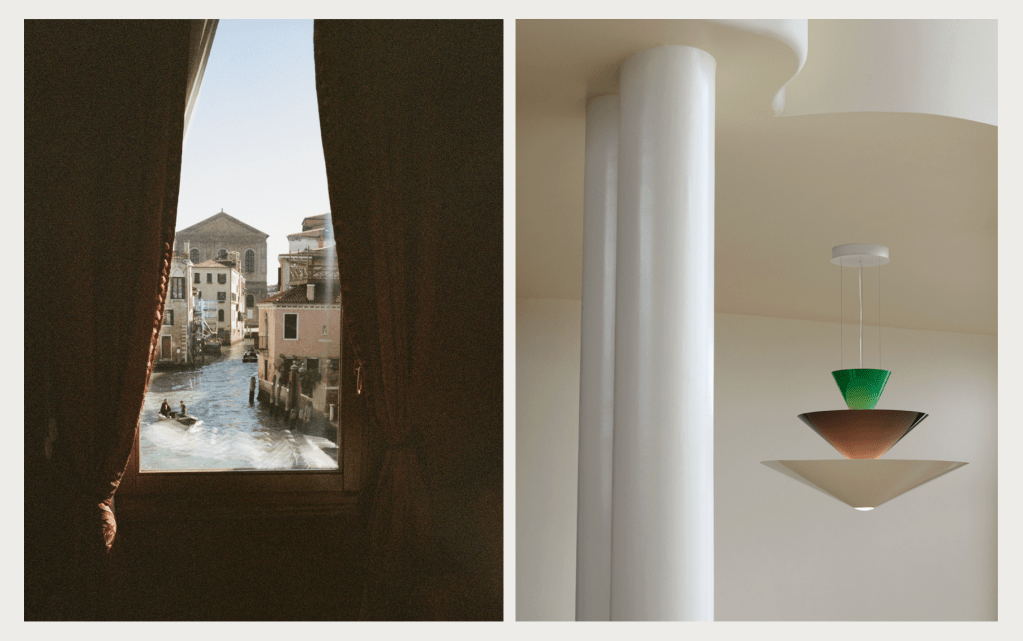
“Raised on the small Venetian Island of Murano, famously shaped by the everlasting charm of the Murano glass industry, Luca Nichetto’s relocation to Sweden has only strengthened his sense of self. Working between his practices in Stockholm and Venice, ten years of partnership with &Tradition has inspired the creation of Gio, a new pendant lamp that explores the exquisite design heritage of his homeland.
Gio was not a product of a specific brief. It was something closer to a question: “Luca, you have designed lounge chairs, sofas, tables and a wall lamp with us so far, what would you like to see now from our collaboration?” The answer was quite clear to me: I wanted to see a chandelier-like lamp or a big suspension lamp. So, this was our conversational starting point.
Growing up on an island like Murano, where 99% of the people I knew were involved in its glass industry, I look back and realise that there was always a chandelier nearby. In my kitchen, in the bedroom of my grandmother or the living room of my friends–always a big glass chandelier. Of course, in the museums and the palaces in Venice as well–this element was, and is, omnipresent. As a result, a chandelier is something that deeply connects with my idea of what makes an interior.
To me, what is fascinating is the history of the glass chandeliers, which we know were being made in Murano as far back as the 1600s. Back then, they were exclusively for the rich, with many being exported from Venice to wealthy places like France. The chandelier was popular among the upper classes as it gave this perception of grandeur, of regal parlour rooms.
Fast forward to the 1900s and we see the rise of Gio Ponti, known to many as ‘The Father of Modern Italian Design’. A major figure not only in Italy, but due to his work with Arne Jacobsen, in Denmark too. Ponti was a multitalented creative; a director of a magazine, an architect, a product designer–he was significant at every cultural level. He was the figure that guided Italian design from the classicism to the contemporary.
One great example of this was his time spent as the director of the Italian porcelain company, Ginori. Before his arrival, the detailing of their pieces was comparable to that of the Renaissance period, but with Ponti’s influence it became much cleaner and much fresher. Within the realm of glasswork in general, he was the first to take the classic chandelier and clean it up, stripping it of all its ornaments. He created a whole new kind of chandelier which was much simpler in form but centred a strategic use of coloured glass.
I started to think about how this type of approach could be done today, for Gio. I began to think about the 3D image drawing process in the computer programme CAD and how sometimes, when you design something with it, the computer software will simplify it into some form of a polygon. I asked myself, if I had made a chandelier with this programme and my computer needed to simplify it, what would it be? Three cones. I worked with this notion of hyper-simplification, but colour-wise, I wanted to maintain the impact of a Ponti chandelier, so, I worked with his original colours. They didn’t quite work together in one chandelier, and that’s how we ended up with the two colourways: one warm-toned and one cool-toned. I wanted the instant reaction to be that yes, we have this bold colour, this pop, but simultaneously, I wanted to maintain this perception of grandeur – this is how I came to the glossy finish.
You then have a double effect with the light – there’s this indirect up-light that creates a glow in the room, but also a lens at the tip of the bottom cone that shines a spotlight below. This was difficult to achieve. I wanted a really thick lens, but it also had to merge seamlessly with the cone. In my opinion this really changes the final result of the product and I was insistent on it. I know was particular and I pushed a lot, but when I saw the lamp styled in the &Tradition showroom, I was so happy with it. It really has this aura of grandiosity. The trouble was all worth it!
So, that was the exercise. To merge this rich storytelling of glass chandelier’s history, an interpretation of that in design if you will, with the DNA of &Tradition. This combination made Gio–this is Gio’s story.”
 M A Richards
Leave a comment