From the Archive
British designer Robin Day (1915-2010) grew up in the furniture making town of High Wycombe, surrounded by timber yards and cabinetmaking workshops. After studying at a local technical institute and art school, he won a scholarship to the Royal College of Art in London to study product, furniture, and interior design. His aspirations to become a furniture designer were halted by World War II, during which he honed his skills in various creative professions. He eventually became a prolific exhibition designer and finally, a world-renowned furniture designer.
His big break came in 1948 when he entered and won First Prize in the storage section of New York Museum of Modern Art’s Low-Cost Furniture Competition with his partner, Clive Latimer. The win led to two significant outcomes: his commission to design all furniture for the Royal Festival Hall in 1951, and his long-term relationship with the British furniture company Hille – for whom he designed the Hillestak collection, now reissued under the new name Daystak. We spoke to Paula Day, daughter of Robin Day and Founder of the Robin Day and Lucienne Day Foundation, about her father’s legacy and the reissued Daystak and RFH collections for &Tradition.
Robin Day’s design history spans decades and his repertoire is vast. How do you think he continued to create for so many years and with such enthusiasm?
My father came from a family in very modest circumstances. His dad was a police constable and his mum had been a nurse. They were living in a very small house on a very limited income, and his parents worked to give the family a good life by being very creative and making things themselves. His mother made all the family’s clothes, his father mended the boys’ boots, made furniture and grew produce in the garden. So, he grew up understanding that, with creativity and imagination, good things could be made using minimal resources.
Speaking of Day’s childhood, do you have any personal memories of your own of the RFH and Daystak collections?
The RFH designs sat in the Royal Festival Hall itself and so I wasn’t around those much as a child. But I did my homework on a Hillestak desk and chair – I thought nothing of them as to me it seemed that they had always been there! Of course, I now appreciate the designs and their importance, but at the time I didn’t. So, I have a very personal connection with the Daystak pieces.
At the time Day created the RFH furniture, their form, especially that of the lounge chair and armchair, would have been unlike any design available in the UK before. Do you have thoughts on what may have inspired him?
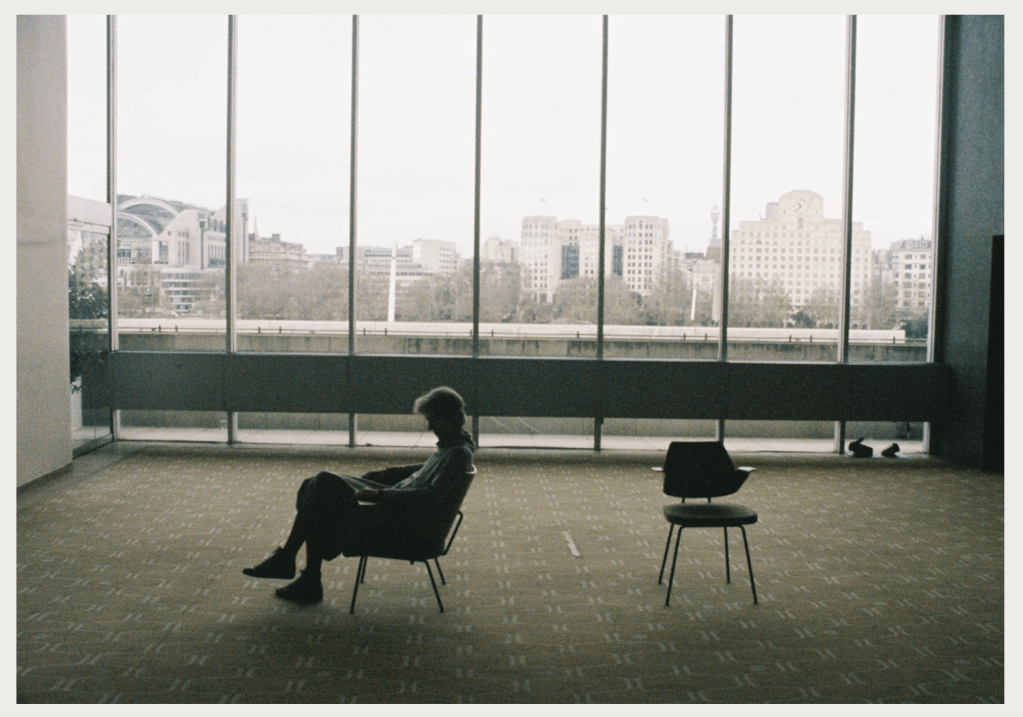
I think you have to think of them in the context of the Festival of Britain, which was when the Royal Festival Hall opened in 1951. The whole ethos of the Festival was about renewal and optimism and hope. If you look at the designs and the architecture, they expressed a sort of lightness, festivity, fantasia, celebration. I think that my father’s designs epitomised that. They have a kind of birdlike quality, a sense of levitation. The Festival and my father’s early work are inextricable really. Nothing in his later work has quite that kind of playfulness. He was quite an austere designer in some ways, understatement was part of his strength. However, in those early pieces, I think he was absolutely responding to that Festival energy, to the Royal Festival Hall architecture and Peter Moro’s Interiors, which have that sense of lightness.
Hillestak was an incredibly successful, beautiful and robust design which was seen everywhere from private homes to school canteens and even church halls. How did the Hillestak designs fit into your father’s life?
He married my mother, textile designer Lucienne Day, during the Second World War. Their first home, for ten years in fact, was their flat at Markham Square in London. There wasn’t much modern furniture available. There wasn’t much furniture available at all actually, and so he furnished the flat by making most of the pieces himself, from things he’d found in skips and so on. He was interested in how modernist designers like Eames and Aalto had used moulded plywood to make furniture, so he made dining chairs from ply which he cut out and bent with steam from a domestic kettle. These homemade pieces were a primitive precursor of the Hillestak chair, with its moulded plywood seat and backrest.
Day’s designs were relatively small in proportion and often multipurpose, reflecting the conditions set by the MoMA competition he was successful in. What do you think he found to be so compelling about these qualities?
I believe that his upbringing stayed with him the whole of his life and shaped his outlook on things. He understood that many people lived on a budget and in smaller spaces. He was instinctively frugal in everything he did, right down to his economical use of materials and production methods. That outlook continued right through the sixties, when in fact he was a very commercially successful designer. Of course, in his later years, when people began to think about sustainability and the environmental crisis, it all made total sense to him. That was how he understood the world anyway, that there must be limits to how we use resources, and we need to be creative with what we already have.
 M A Richards
Leave a comment