Blending the rich design heritage of Scandinavian minimalism with the subtleties of Japanese craftsmanship, OEO Studio is a Copenhagen-based studio with a project office in Tokyo. Shying away from the oversaturated notion of Japandi, guided instead by their ethos of Compelling Minimalism, the Ita collection for &Tradition leaves only what is necessary. We talk to Thomas Lykke, Head of Design at OEO, about the pieces and discuss that which might not immediately meet the eye.
The new Ita collection is rooted in the sentiment that enough is enough. How have you ensured that it still stands out from the crowd?
The world is flooded with products. Naturally, it can be quite difficult to bring something new to the table, so to speak. We always strive to bring something different, but it can be very subtle, it can even be in a detail that you find in a process such as the assembly—which of course is true in the case of Ita.
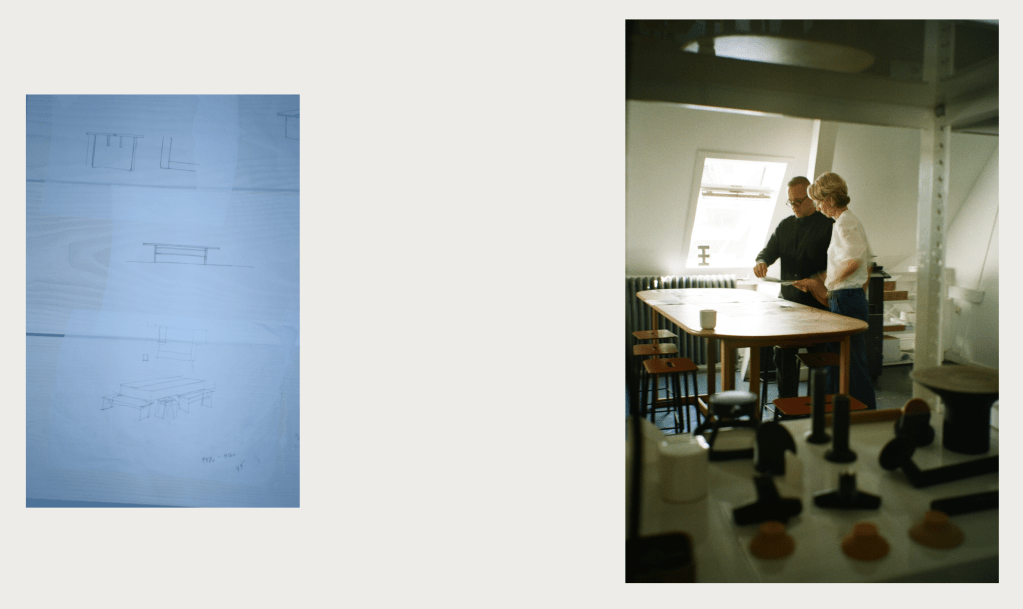
Often the simplest ideas are the most complicated. The whole ethos of Ita is its flat-packing and easy assembly. We wanted to create a design that is super easy to put together with almost no tools, just like the Japanese wood craftsmanship of miyadaiku—which was also what inspired us for Ita.
What does Ita mean?
Just as many words in Japanese have many meanings, Ita does too. The way we use it is in the sense that it means a plank or slab of wood, which at its core meaning, refers to the visual language of the collection.
It’s simple, but sometimes it’s much easier to design something that has a lot of detail than to have something that is simple. To quote Leonardo da Vinci, “Simplicity is the ultimate sophistication.” I think this is very much the case.
You have been visiting Japan for over two decades. You also have a project office in Tokyo and a newly released book that chronicles much of your time there. What is it about Japan that continues to inspire your work?
I have a strong belief that our aesthetic comes from a fusion of cultures and a shared appreciation for similar facets. We find that we are often inspired by something very subtle that we stumble upon while we are there, then this becomes a little detail in our work; which is very much in line with how our old masters of Danish design evolved their work. If you look at Hans Wegner or Poul Kjærholm, at Finn Juhl, Kaare Klint, they all sought inspiration in other cultures. I think that it’s very much about having an open mind and a willingness to be influenced.
This exploration also led to the development of your ethos Compelling Minimalism. Can you tell us more about that?
Compelling Minimalism is how we define our style. It’s something that we have evolved over the years and is really what we feel is us. It’s quite interesting when you ask “what does it mean?”. Of course, compelling is something you are drawn to and minimalism is about taking away and removing. I think over the years, the meaning of minimalism has become distorted. It’s not just a white room–of course that is minimal–but it’s so much more. It’s about finding tranquility. To us, Compelling Minimalism is not about taking away richness, it’s about finding the balance of enough is enough – only including details that should be there, ones that should also have a purpose.
Minimalism has certainly become a bit of a buzzword.
Yes, a trend if you will. I’m not a great fan of trends. They dilute the message—and that is probably why I’m not a big fan of things like Japandi. It reduces everything to just one word and I don’t think that’s fair to either Japan or Scandinavia. There’s so much history and knowledge and passion and then you simply take it all and condense it. I often think: “How can you adopt something like Japandi if you live over the other side of the world, when you are far from both Scandinavia and Japan?” At that point it has been taken so far out of context, both metaphorically and geographically, and has just become a style, right?
So, these trends, I think they’re very limiting in that sense. Maybe it’s great for communication but just for a very short period in time. The storytelling of the qualities of Japan and Scandinavia, the similarities of the two, how do they relate? I think that’s much more interesting than just one word.
It’s about the permanence of the qualities as opposed to the impermanence of this Japandi word.
Yes exactly. It’s especially true of a country like Japan, a place where it is so ingrained in the conscious culture that one should really study something in order to become good at it. Whether it’s woodworking or pottery or textile—whatever it is. It’s about nurturing something deep within yourself over the course of a lifetime in order to do it extremely well. I think it’s more respectful to not assign a word like Japandi to a practice which has underlying connotations of bridging two cultures together. It’s very much never been about paying homage to Japan, but about a respect for Japan.
I think these are two very different things—paying homage to a country is more– I’ll show you how I see it. That’s not how we see it. We are not showing the world that we pay tribute to Japan. It’s more respectful just to be subtle about it. Does that make sense? I think it’s a big thing that does not only apply to the word Japandi–the same can be said for many things in life.
This way of thinking is embedded in our working practices and reflected in Ita. We believe in design that scratches below the surface and speaks to people on an emotional level. To us, design is more than what you see, it’s what you experience.
 M A Richards
Leave a comment