Documentary work with &Tradition and Apartamento
1951 marked a pivotal year in Robin Day’s design history, as it unfolded amidst a dynamic cultural landscape, characterised by a resurgence of widespread creativity and innovation. Against the backdrop of post-war recovery, significant events unfolded, leaving an enduring imprint on the collective consciousness.
Among those noteworthy events: J.D. Salinger’s influential coming-of-age novel, The Catcher in the Rye, was published; the Universal Automatic Computer I became the first commercially available computer in the United States, marking the beginning of the computer age in business; and the first colour photograph of the world was taken from space, providing a stunning view of our planet’s curvature, marking a significant milestone in the exploration of space. Additionally, 1951 was the year of conception for two groundbreaking furniture collections, Daystak and RFH, reissued into &Tradition’s classic designs, decades later.
This year also bore significant importance to the British design scene and a number of its key players. In Britain, members of the general public were anticipating a cultural, nationwide event, on a scale at which the country had never experienced before. The 1951 Festival of Britain was held in London to mark the centenary of the Great Exhibition of 1851. The festival’s attendance at the main site alone, which was situated on London’s Southbank, was around 8.5 million. It showcased the best of British art, science, and industry, featuring exhibitions, performances, and events across Scotland, England, Wales and Northern Ireland. It aimed to boost national morale in the aftermath of World War II and promote British culture and innovation on the world stage. After years of austerity and war sanctions, people were optimistic about the future and excited to welcome back creativity and prosperity into their lives.
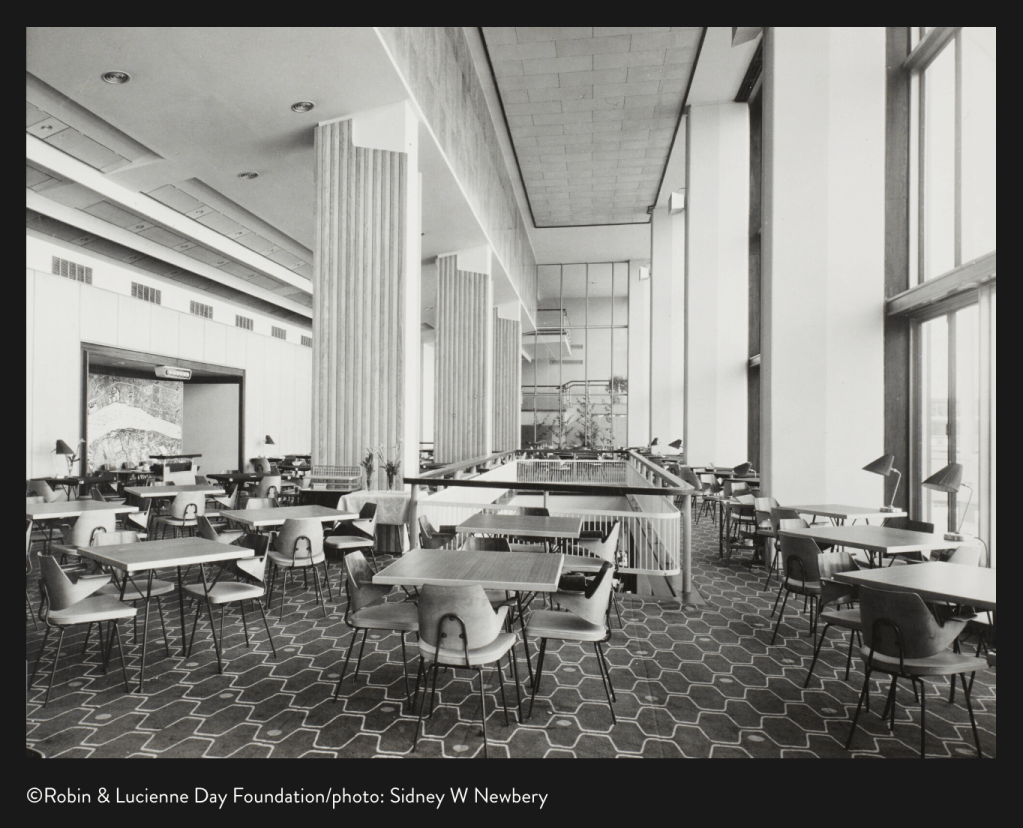
One aforementioned key player in the British design scene at the time was a young, eager Robin Day. Having recently won First Place, in partnership with Clive Latimer, in the storage section of New York Museum of Modern Art’s International Competition for Low-Cost Furniture Design in 1948, his career as a furniture designer was on the brink of taking off. Now an institution of both historical significance and cultural importance, the Royal Festival Hall building opened as part of the Festival of Britain in 1951. Fresh from his success in the MoMA competition, Day’s expertise was enlisted by his friend and kindred spirit Peter Moro, the architect responsible for designing the building’s interiors. The commission to design all the furniture for the new building was a huge responsibility and opportunity. His revolutionary auditorium seating is still in use at the Royal Festival Hall today, and he also designed strikingly modern seating for the restaurant, foyers and public spaces, which would adorn the building for decades.
Recognised for their timeless aesthetic and striking form, four pieces originally designed for the Royal Festival Hall now sit proudly in the &Tradition classics collection. The RFH Armchair was originally designed for the Festival Hall restaurant while the RFH Lounge Chair was designed for the Festival Hall’s foyer. Day’s client, the British furniture company Hille, subsequently put these two designs into general production, but only a handful of the original RFH Lounge Chairs supplied to the Royal Festival Hall now survive, one of them in the permanent collection of MoMA, New York. A very rare piece held in a private collection in northern England provided the template for developing the reissue. A similar story is true of the terrace designs which, unlike the lounge and dining chair, never made it into general production. The original models of the RFH Terrace Chair and RFH Terrace Table, now produced in two sizes, sat on the Festival Hall’s terrace and were made in a limited number.
A couple of archive photographs were the only evidence for the designs, and it took months of searching to eventually find a single surviving example of the chair in the Royal Festival Hall archives, where it had lain tightly wrapped and untouched for years – a discovery which allowed the development of a reissue which is true to the original.
Before becoming an established furniture designer, during the war, Day developed his skills in various creative and design-related industries. His versatility and experience in both exhibition and graphic design made Day an ideal candidate for the 1951 Festival of Britain organisers, who assigned him to create posters, signage and room setting displays for the Home Entertainment Section of the Homes and Gardens Pavilion. These room sets gave him the opportunity to show how his radical new moulded plywood designs for the Royal Festival Hall could be used in a domestic space. He deployed his RFH Orchestra Chairs in the compact Low-Cost Room Set, while the more expansive High-Cost Room Set was furnished with his RFH Dining Chair (now renamed RFH Armchair)and RFH Lounge Chair. The Festival was also a breakthrough moment for Lucienne Day, who designed her trailblazing textile, Calyx, to complement Day’s furniture in a backdrop to his room setting.
Winning the 1948 MoMA Low-Cost Furniture competition was a pivotal moment in Day’s career. As well as making him an obvious candidate for the Royal Festival Hall and Festival of Britain commissions, it also sparked his almost life-long partnership with Hille. The first low-cost furniture collection he made for the company, Day’s Hillestak (reissued under the name Daystak for &Tradition), consisted of a stacking chair, a stacking table and a desk. The collection was inspired by the potential of moulded plywood as a material and the ethos of the MoMA competition, which aimed to find affordable housing and furniture options suitable for compact living spaces.
Day’s successes at the Festival resulted in a personal invitation to represent Britain with a display at the ninth Milan Triennale, also in 1951. With funding from Hille, Day designed and personally arranged a display similar to his Festival of Britain High-Cost room set, featuring his RFH Lounge and Dining Chairs and Lucienne’s eye-catching textile design, Calyx. The stand took the event by storm, with both designers winning Gold Medals.
Day went on to produce a prolific body of furniture design in a career which lasted nearly seven decades. He believed that good design could contribute to the quality of everyone’s lives, and his later work, such as the world’s first Polypropylene Chair and the Toro benches used on the London Underground, endure as iconic pieces of British design.
 M A Richards
Leave a comment